The 3 House Rules I'm Setting Before This House Fills Up (Ep 329)
About the episode
Willpower runs out exactly when you need it, so I set house rules instead. Three if this, then that rules for the no, the surface, and the maybe, from our first two weeks in a new house.
Powered by RedCircle



Helpful Links:
Links mentioned in this episode (some may be affiliate links):
Check out 1-800-GOT-JUNK and use my code 1800gotjunk.com for a great deal: https://www.1800gotjunk.com
Check out Omaha Steaks and use my code BEEF for a great deal: https://www.omahasteaks.com
Check out BetterHelp and get 10% off at BetterHelp.com
I'm coming to you from our new house, and yes, there are still boxes. There are actually more boxes in my office than last week, because I'm running a Packing Party. Most of my things are staying packed, and I take them out only as I need them.
The movers came 12 days ago. We're unpacked enough that our nightly resets have started again, which feels like a small miracle.
But here's what I've really been doing. I haven't just been unpacking this house. I've been deciding how it's going to work.
A House Decides How It Works in the First Few Weeks
I've moved 17 times as an adult. No, we're not military. We've just moved a lot.
Here's what I've learned. Where you put something the first time is usually where it lives for as long as you're in that house. And if you change it later, everyone gets thrown off. I rearranged the kitchen in our last house and we were out of sync for weeks while new habits formed.
So this time I'm being deliberate. I'm letting the house talk to me before I force it to work a certain way.
My Twist on the Packing Party
We packed our old house in less than a week, roughly Sunday through Friday. A lot of things got thrown into boxes at the end, and I was not as organized as I wanted to be.
So on this end, I'm doing something I wouldn't necessarily recommend to everyone. As I go through boxes, I'm re-sorting things into category boxes. Kitchen things in a kitchen box. Office things together. It's an extra step, but it means I can find what I need when I need it.
Right now I have three boxes behind me: office items I haven't unpacked, a box of extension cords and surge protectors that appeared out of nowhere, and a toss box I'm filling so I'm not making a donation run every single day.
Why Rules Beat Willpower
Moving makes you make hundreds of decisions. Keep it, toss it, box it, label it, where does it go, does it even come with us.
By the end of a day like that, I couldn't decide anything else. Not dinner. Not where a single spoon should go. That's what an empty decision budget feels like, and you don't need a move to find it. A regular Tuesday will do it.
This is why willpower fails. Willpower is wonderful when you're rested and well fed. It disappears at exactly the moment you need it.
Your house isn't cluttered because you don't care. Your house is cluttered because every item in it is asking you to make a decision, all day long.
Rules are different. You decide once, in advance, while you're thinking clearly. Then the rule carries it for you.
What Makes a Rule Actually Work
A rule has two parts: a trigger you'll actually notice, and one action.
"Be tidier" is not a rule. "Keep your surfaces clear" is not a rule. There's no trigger, so there's no action. It's a wish with a stern voice, and both of those carry a little shame. Be tidier means you're not tidy. Keep surfaces clear means you're failing.
We're not leading with shame. We're making better rules.
If this, then that. And the trigger has to be impossible to miss. If you have to remember your rule, it isn't a rule yet.
My three rules cover three different places a house falls apart: the no, the surfaces, and the maybe.
Rule One: If You Know It's a No, Then It Goes in the Bin
If you pick something up and you know you don't want it, it goes straight into the donation bin. No hemming, no hawing, no setting it back down.
The trigger is the moment you know. Not the end of the session, not next weekend. That second.
Here's where we lose things. You pick it up, you know it's a no, and you set it back down because you have to get your kid to school or start a podcast or make dinner. Next time you see it, you have to decide all over again. Sometimes a third and fourth time. And sometimes you talk yourself into keeping something you knew you didn't want.
You already decided. The rule keeps you from unmaking it.
This rule needs one thing: a donation bin that always exists and sits somewhere in your daily path. Right now I have one in every upstairs bedroom closet and one downstairs in the living room, front and center while we unpack. Once we're settled, that one will move to the entry closet or the garage, because I expect far fewer donations once this first pass is done.
If you haven't decluttered much before, keep the bin visible. It's a reminder of what you're working toward. Once you're further along, it can live somewhere quieter.
The example everyone recognizes: clothes. You try something on, look in the mirror, and take it right back off. Too tight at the waist. Sleeves that don't sit right. A color that isn't yours. You knew in seconds. Don't put it back on the hanger, where it takes up space and reminds you every time you see it. Put it in the bin.
It's not only clothes. It's the utensil you keep passing up. The lid with no container. The toy nobody has touched since spring. And if something is broken, throw it away rather than donating it. Broken items end up in a landfill anyway, so take responsibility the first time.
Rule Two: If You Have a Flat Surface, Put a Container on It
This one sounds backwards. You want the surface clear, so why put something on it?
If you're a person who can keep a flat surface completely empty, wonderful. You're probably not listening to this podcast. I'm not that person, and my family isn't either.
A tray, a bowl, a basket, or a bin corrals the things that land there. Flat surfaces invite spreading. One set of keys turns into eight things by the end of the day, and none of it looks like it belongs anywhere.
A container gives those things a place and a boundary at the same time. And here's my favorite part: it tells you when it's too much. When the tray overflows, your house is telling you it's time to deal with it. You don't have to notice on your own.
The surface isn't the problem. A surface with no boundary is the problem.
Three that are working in my house:
The console. Our old entertainment unit doesn't work here because the TV setup is built into the wall. It fits perfectly behind our floating couch, so it became a console table. It sits dead center downstairs, which makes it a magnet. Now there's a tray on it, and everything that lands there goes in the tray.
The entry bin. Keys, wallets, sunglasses. The things in your hands when you walk in. If there's no place to put them, they stay in my hand and migrate, and then I can't find them on the way out.
The fruit bowl. It looks like decor, but it's doing the same job. Bananas and tomatoes and anything still ripening. It also nudges me toward a banana instead of a cookie.
They hold things all day, and at the end of the day it's fast to put everything away. I'm not walking the whole house gathering items. I work from home, and visual clutter really gets to me. These have made a bigger difference than almost anything else.
One caution: this is a rule, not decor. Things go IN it. A beautiful empty tray with piles around it isn't helping.
And don't rush out to buy bins. Cut the top off an Amazon box and test the idea first. Make sure it works before you add more stuff to your home.
Rule Three: If You Hesitate, Then It Goes in the Pause Box
If you pick something up and you hesitate, it goes in the Pause Box. The hesitation is the signal.
Unsure items stall an entire decluttering session. You hold one thing, go back and forth, and then you're done for the day. Not because you ran out of time, but because you ran out of decisions.
This rule takes the hard ones off the table so you can keep moving through the easy stuff and build the muscle. Later, those harder items are easier. Either you find the perfect spot for something that used to be crowded out, or you look around and realize you like the space better without it.
Put the unsure things in the box, out of sight, and live without them for a while.
The part most people skip: consult the box before you buy anything new. Things go out of sight and out of mind, and that's how people end up rebuying what they already own.
And put a date on the box, or it quietly becomes storage. One week turns into two, then a month, then half a year, and then you have boxes in the garage and no idea what's in them. I usually recommend one to three months.
This is what we're doing with my daughter's unpacking, and it's why we started calling it a Pause Box. It's a pause, not a goodbye. We're revisiting hers at the end of November, which gives us time before the holidays. If she's ready to part with something, it can go out to our Buy Nothing group while people are looking for gifts, rather than waiting for the January decluttering rush.
Other people have their own version of this. Dawn at The Minimal Mom calls hers a Time Will Tell box, and I've heard people call it a maybe box. Same good idea. Call it whatever works for you.
Why Now, and Why Out Loud
I'm setting the standard before the house fills up, not after.
That's the fresh start I talked about in episode 327. A move is the most obvious one, but you can start on a Monday, on the first of the month, on the day school starts, or when a break begins.
Here's the part people skip: say the rules out loud to the people you live with. A rule nobody else knows about is just something that will annoy you.
My family is on board with clear surfaces and closed storage, and house hunting is what did it. Walking through bright, empty homes made the idea real in a way that talking about it never did. Our house wasn't cluttered, but seeing that contrast got everyone thinking we could do a little better.
Getting your family on board is a big ask. Rules are small. They change behavior without nagging.
We already do this with bedtimes and toothbrushing. These are just house rules for your stuff.
Your Challenge This Week
Pick one to three rules. Not ten.
Write them as if this, then that, with a trigger you can't miss. Then say them out loud to whoever lives with you. Bring it up at dinner tonight and ask everyone to contribute one. People get on board when they help build the thing.
If you want a place to start, put a donation box where each person in your house gets dressed.
Then come tell me your house rules. I'm @wannabeclutterfree on Instagram.
What's Next
I'm running my Packing Party for one month from the day the movers came, so results come at the end of October. I'll tell you what I actually took out of boxes, what I never touched, and where all of it ends up.
And next week we're sorting out something that trips up almost everybody: decluttering, tidying, cleaning, and organizing are four different jobs.
Connect
Follow along in real time on Instagram at @WannabeClutterFree. I am documenting every single day of this.
New episodes every Wednesday. Find all the show notes at wannabeclutterfree.com.
Don't forget to subscribe to the Wannabe Clutter Free podcast (on your favorite podcast player!) so you never miss an episode. And if you liked what you heard today, please leave a rating and review for the show too! It helps others find the show and makes my day.
BEFORE YOU GO!
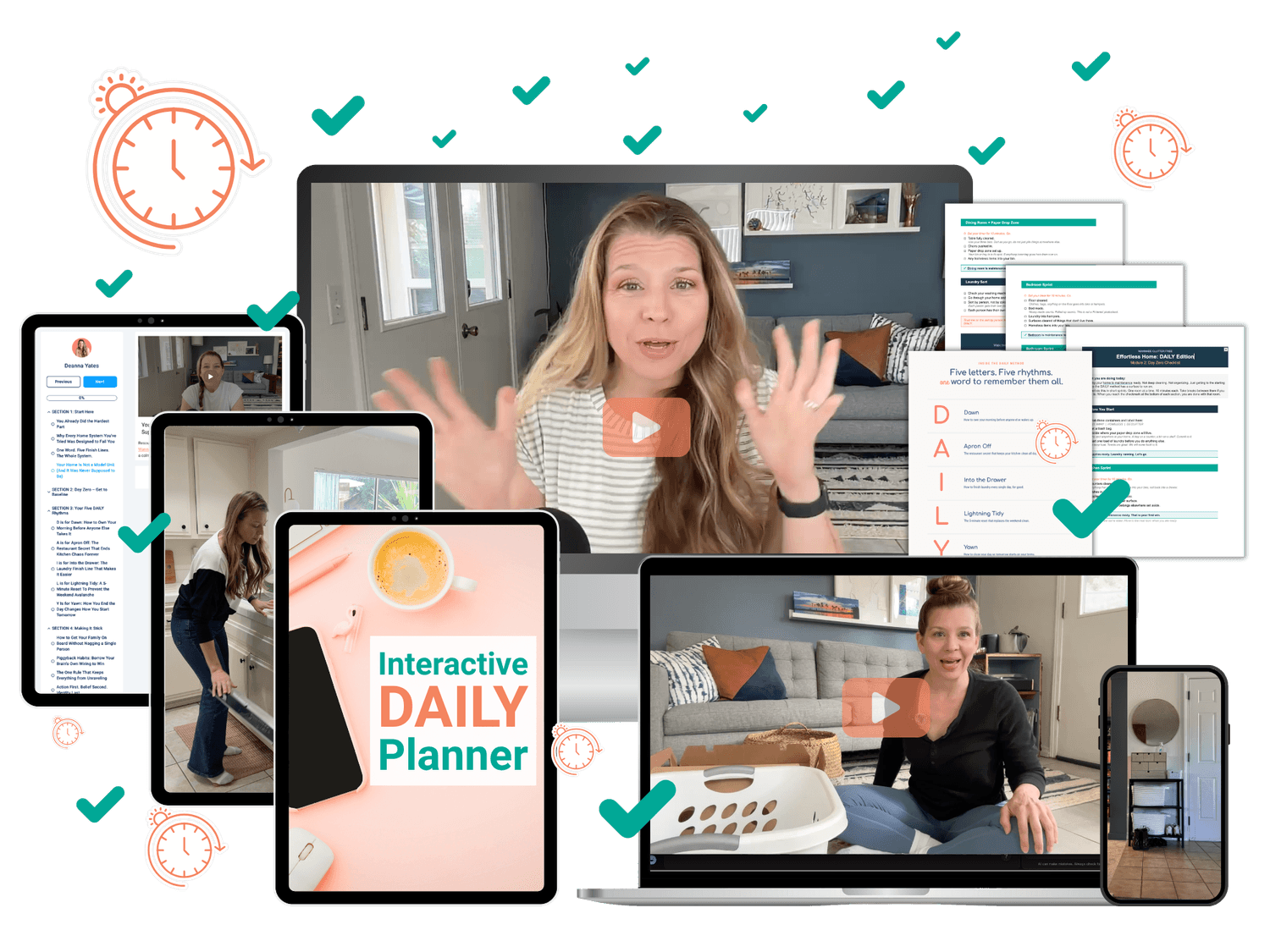
✨ Snag my DAILY routine that keeps my home tidy & calm in just minutes a day ✨
cheers!
About Deanna Yates
Based in San Diego, CA, Deanna helps high-achieving moms clear the clutter from their homes and lives.
Through coaching, courses, summits, and her top-ranked Wannabe Clutter Free podcast, she supports modern women in building organized, peaceful homes where they can thrive.


Some of the links on this site are affiliate links for your convenience (which means if you make a purchase after clicking a link I will earn a small commission but it won’t cost you a penny more)! Read my full disclosure policy.
Wannabe Clutter Free is a participant in the Amazon Services LLC Associates Program, an affiliate advertising program designed to provide a means for sites to earn advertising fees by advertising and linking to Amazon.com.
© 2026. All Rights Reserved